The Hottest Role in the AI Era
Only when you truly understand the problem will AI and Agents know where to step in and drive results.
Penny Dinh · July 08, 2026
If you know how to deconstruct a business problem, you already hold over half the critical skillset for one of the most in-demand career paths of the next few years.
The biggest gap stopping most companies from adopting AI isn't a lack of models, software, or yet another AI Agent. The biggest gap is a shortage of people who can walk into a business, understand the actual problems, real workflows, and real people, and turn AI into a working solution in daily operations.
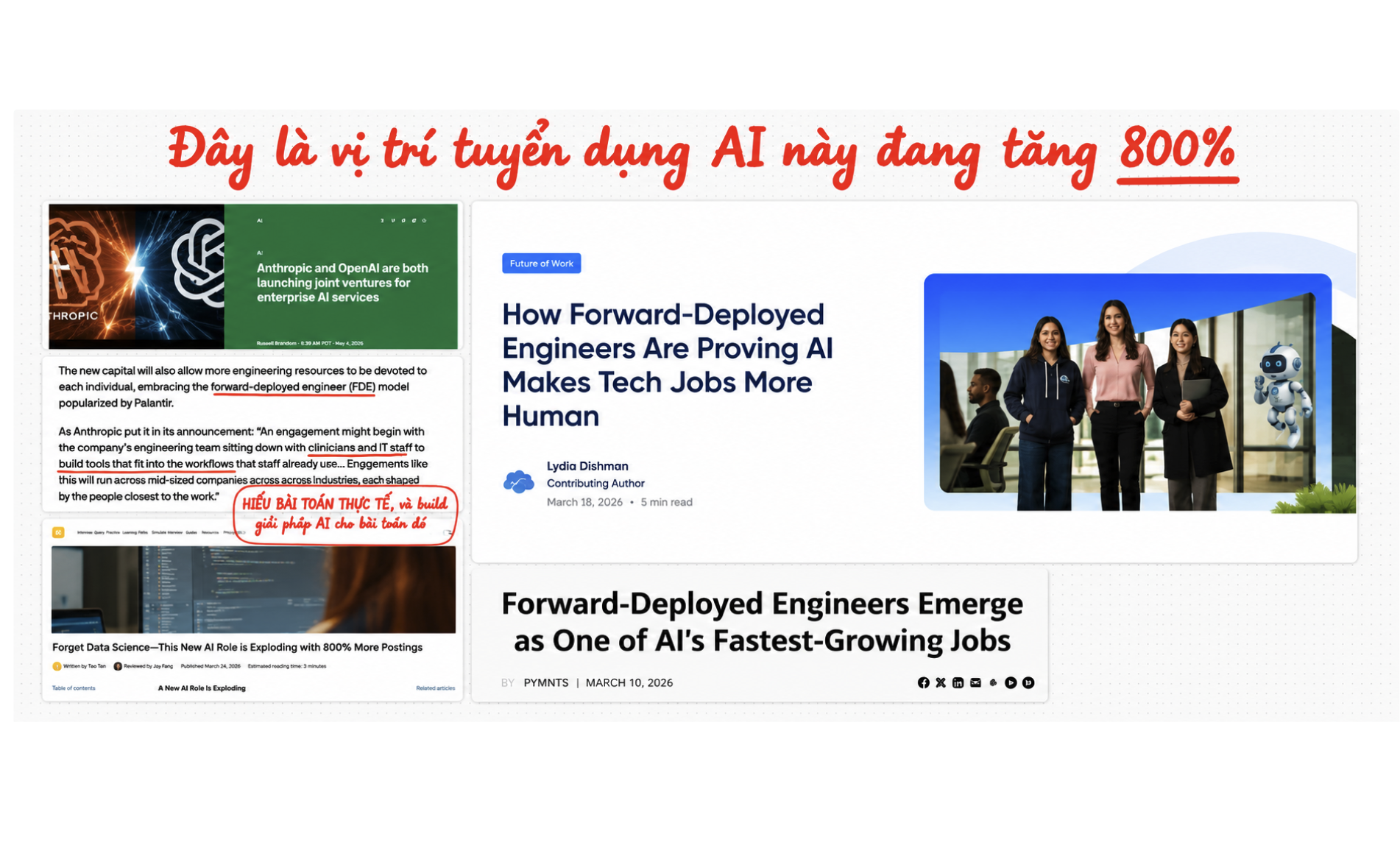
This is why the Forward Deployed Engineer (FDE) role is suddenly everywhere. Salesforce calls FDE one of the hottest roles right now, combining technical skills, business consulting, and hands-on execution to help companies put AI Agents into production. Salesforce's report noted that job postings for this role surged by over 800% between January and September 2025, and Salesforce pledged to build a dedicated team of 1,000 FDEs.
But what made me pause wasn't that massive number.
What caught my attention was: who is actually filling these roles?
Forward Deployed Engineers aren't just coders
Hearing the title "Forward Deployed Engineer," most people assume it's strictly for hardcore engineers, coders, and deep technical folks. Sure, technical chops matter. But if you look closer, an FDE isn't just someone sitting around writing code based on a spec sheet.
FDEs work shoulder-to-shoulder with clients, diving straight into real business environments—understanding workflows, data, underlying problems, and *why* a request is being made—before designing and deploying the right AI solution. They need more than technical skills; they need problem-solving, communication, and business acumen—meaning the ability to grasp the actual business logic behind a client's request.
OpenAI is following a similar playbook with the launch of the OpenAI Deployment Company, embedding FDEs into client organizations to wire models into real data, tools, control points, and business operations. OpenAI made it crystal clear: the next phase of enterprise AI is all about deploying tech into real use cases and production workflows, not just flashy demos or surface-level experiments.
Anthropic is also hiring Forward Deployed Engineers for their Applied AI team to work directly with strategic clients, build AI apps that solve real business problems, ship products into production workflows, and collaborate with product, engineering, and post-sales teams.
In other words, this is no longer about "just knowing how to code."
This role sits right at the intersection of domain expertise, product thinking, operations, business, engineering, and AI.
Domain experts have a massive edge
I think this is the key point a lot of people are missing.
The AI era doesn't mean domain expertise loses value. On the contrary, subject-matter expertise is more critical than ever.
A marketer understands customer behavior, knows what content drives conversions, where ads fail, and why a neat concept might be impossible to scale. A salesperson knows what prospects ask, where deals close, and what objections pop up repeatedly. An operations manager knows where bottlenecks are, where data lives, who's stuck doing tedious manual work, and which repetitive steps lack standardization. A consultant or project manager knows how to break down problems, map stakeholders, manage scope, and take a solution from concept to execution.
If these people learn how to leverage AI properly, they have an unfair advantage.
Because AI doesn't know which problems are worth solving on its own. AI won't understand your industry unless you feed it the right context. And AI can't tell if an output is good enough for your market unless you set the standard.
To use AI effectively, you need actual domain expertise.
You don't necessarily need a tech background right out of the gate, but you must know the domain you're solving for. Otherwise, it's way too easy to get caught up in fancy tools, demos, and cool-looking workflows that you have no idea how to apply in real life.
The issue isn't that you're not smart enough—it's that you're focusing on the wrong things in AI
I meet plenty of folks in marketing, business, ops, content, ads, and project management who consume AI content daily, bookmark dozens of tools, test endless prompts, and listen to case studies. Yet they still end up asking themselves: “So... how do I actually apply this to my daily job?”
I don't think it's because you aren't capable enough.
The problem is that most AI content out there focuses on the wrong things.
It shows you a black screen running code, terminal outputs, slick demos, or futuristic autonomous agents running tasks. But it doesn't teach you how to sit back down at your desk and break down:
What's the real problem?
Who is hurting, and where?
Where is the data stored?
How does the current process actually run?
Which steps can AI assist with?
Which steps still require a human decision?
What counts as a usable output?
How do we measure success?
Without that layer of strategic thinking, you can study AI all day and still end up stuck in the exact same spot. Not because AI is hard, but because you haven't learned to frame it around a real problem.
Deconstructing the problem is the core skill
From my experience, the single most critical skill in the AI age isn't knowing a million tools. It's knowing how to deconstruct a problem.
Deconstructing a problem means never stopping at surface-level requests.
A client says: “I want a chatbot.”
But the real problem might be: customer support is drowning in repetitive FAQs.
A client says: “I want marketing automation.”
But the real problem might be: leads are coming in, but nobody is scoring or nurturing them, so sales doesn't know who to prioritize.
A client says: “I want an enterprise AI Agent.”
But the real problem might be: data is scattered, workflows are messy, every department operates in a silo, and there's no central dashboard.
A client says: “I want AI content generation.”
But the real problem might be: the brand lacks clear positioning, doesn't get customer insights, and has no distribution system—so churning out faster AI content won't fix conversion.
High-performing individuals don't just take orders and blindly execute. They peel back the layers: Why do they need this? What bottleneck does it solve? If we build this, what business metric actually moves?
That's the exact area where AI desperately needs human guidance.
AI won't understand the problem for you
I don't come from a traditional tech background, nor did I start out coding. But one thing is crystal clear to me: once you know what problem you're trying to solve, AI becomes infinitely easier to use.
Because at that point, you stop asking generic questions like “What can AI do?”
Instead, you ask specific ones: “Here is my workflow, here is where my data lives, here is the required output—how should I structure this flow?”
That's where the real difference lies.
Someone without a clear problem statement will feel overwhelmed by AI—too many tools, too much noise, never knowing where to start. Someone who clearly understands the problem knows exactly what to ask, test, build, and ignore.
AI is insanely powerful when the problem is clearly framed.
But if the problem is vague, AI will just produce even vaguer outputs.
FDE is a mindset, not just a job title
I don't think everyone needs to become an actual Forward Deployed Engineer at a big tech firm. But I do believe the FDE mindset will be a massive competitive advantage for anyone in marketing, ops, business, consulting, product, or solopreneurs building on their own.
That mindset is straightforward:
Deconstruct the problem → Define the goal → Design the solution → Deploy with AI & agents → Measure results → Iterate.
You don't have to code everything from scratch. But you must understand what the solution needs to accomplish. You must know what a good output looks like. You need to decide what to offload to AI, what requires human intervention, what needs deeper tech expertise, and where risk controls are needed.
This is why domain specialists won't lose their edge if they learn AI the right way. If anything, it makes them unstoppable.
A marketer who knows AI can build content workflows, analyze comments, synthesize insights, build landing pages, test concepts, draft scripts, and automate reports. But they still need to understand the market, the customer, positioning, and conversion.
An ops manager who knows AI can consolidate data, categorize tasks, send reminders, generate reports, and automate processing flows. But they still need to understand real-world operations, actual bottlenecks, access permissions, accountability, and risk.
A salesperson who knows AI can summarize call logs, qualify leads, draft follow-ups, and track pipelines. But they still need to understand buyer psychology, timing, and when to step in personally.
AI doesn't diminish domain expertise. It multiplies it for those who know how to use it.
Stop learning AI like it's a laundry list of tools
If your AI learning process consists of bookmarking more tools, testing random prompts, and watching flashy demos, you're going to burn out fast. Every day brings a new tool. Every week, a new workflow. Every month, another “game-changing trick.”
But when you approach AI through the lens of business problems, everything becomes much clearer.
You don't need to know every tool under the sun. You just need to know what bottleneck you're solving.
Want more leads? Look at your funnel, content, landing pages, offer, and tracking.
Want to cut ops time? Look at your process, data flow, repetitive steps, and permissions.
Want better customer support? Look at recurring questions, context, response scripts, and human touchpoints.
Want to produce videos faster? Look at your insights, hooks, storyboards, assets, editing, distribution, and conversion goals.
Once the problem is crystal clear, AI finally has room to deliver real value.
If the problem is fuzzy, collecting more tools just gives you the illusion of learning without driving actual results.
New opportunities for people who actually get things done
Right now, people who actually know how to apply AI are in high demand. In Singapore, salaries for the same roles have jumped significantly for those with AI skills—specifically folks with real-world industry experience who understand operational or growth challenges and know how to turn that insight into AI solutions. Sounds like something everyone wants and needs right now, doesn't it!
They might not be traditional software engineers. They come from marketing, sales, ops, consulting, PM, content, ads, or product. But they share one common trait: they don't learn AI to flex tools. They learn AI to solve real problems.
And that's exactly what I'm doing myself.
If you didn't know, my background is in Growth & Marketing, which is why I have a decent grasp on product thinking.
So build the right mindset around AI and use it to solve actual real-world problems!
P/S:
I spent all of 2024 learning n8n just because I thought it was cool. In April 2025, I shared AI UGC strategies back when the market was still confused about it. By November 2025, I was vibe coding while everyone else was still asking "what is that?".
All because I like tinkering and approach things with the right mindset.
And this page you're reading right now? Built with AI. The message that brought you here? Automated by AI.
If you want to understand how to view business and marketing through an AI lens—not by memorizing tools or technical stuff, but by learning the mindset of where, when, and how to plug it into your business...
I've COMPILED MY COMPLETE SHAREABLE GUIDE with all the details right here!
You have two choices right now.
One – test and figure things out on your own. Totally fine.
Two – if you want to understand the why behind every setup, learn how to plug it into actual business workflows, and save yourself months of trial and error, I've packaged everything up for you.
→ Check out the details at: pennydinh.click